

A Moment (Be)Held
On Polaroid’s SX-70 and the alchemy of presence

[A Polaroid camera] places before you a thing that is more of the thing than the thing was.
—Edwin H. Land
The ballroom lights dimmed in Miami Beach, April 25, 1972. Before an audience of shareholders, journalists, and employees, Edwin H. Land stepped onto the stage holding a small, leather-clad object no larger than a hardback book. Cameras and tape recorders clicked to life. Land unfolded the device in a single, fluid gesture, raised it to his eye, and pressed the shutter. A muted whirring followed. From a narrow slot, a square of white-framed film emerged. Land set it down on a table where, before the audience’s gaze, an image began to appear. There was no darkroom, no peeling of negatives from positives, no chemical trays. He then reportedly declared: “Photography will never be the same after today.”1
That unveiling marked the public debut of the Polaroid SX-70, the company’s most ambitious camera and, arguably, its last great act of unchallenged innovation. Years in development under tight secrecy, it had consumed immense resources and, according to company veterans, as much organizational intensity as the Apollo program demanded of NASA.2 The SX-70 was not simply a camera; it was an argument for what photography could be: instantaneous, tactile, and elegant enough to sit beside a Cartier lighter or a Linn turntable. Land’s demonstration was a piece of corporate theater in which technology’s workings were disguised as sleight of hand.
Even within Polaroid, the SX-70 had taken on near-mythic status before its release. Its code name—Project SX-70—was kept so tightly under wraps that many employees outside the inner circle had no idea what was being built. When it finally emerged, it was a folding single-lens reflex camera with a complex four-mirror optical system, precision glass lens, and integral film that developed without peeling or shaking. The engineering was matched by an aesthetic sensibility: chrome-plated polysulfone masquerading as metal, rich leather panels, and a sleek silhouette that collapsed into a pocketable slab. Industrial designer Henry Dreyfuss collaborated with Land’s team to ensure that the camera’s form matched its transformative function.3
The SX-70 was, as Harry McCracken later observed, “a piece of consumer technology that made good on Arthur C. Clarke’s dictum that sufficiently advanced technology is indistinguishable from magic.”4 The film packs were themselves micro-machines: each contained a “Polapulse” battery to power the camera’s motor, exposure control, and ejection mechanism, meaning the camera needed no separate power source.5 Inside the sealed cassette, each exposure had layers of dye developers, timing layers, and opacifiers; pressing the shutter released the sheet through steel rollers that ruptured chemical pods, spreading the reagent evenly across the film’s surface. The opacifier shielded the image from light during development, gradually clearing as dyes migrated to the receiving layer. This was chemistry choreographed into performance.
For Land, the SX-70 wasn’t just a new product; it was the culmination of decades of work. Polaroid began in 1937 selling polarizing filters for sunglasses and scientific instruments. By the 1940s, Land had pivoted to instant photography, introducing the Model 95 Land Camera in 1948. That first instant camera was bulky and required skill—photographers timed the development manually and peeled apart the print from the negative. Still, it was revolutionary enough to propel Polaroid into the public imagination. By the 1960s, the company had a reputation for merging scientific rigor with consumer elegance, much as Apple would do decades later.6
The SX-70 distilled that dual heritage into a unique object. Critics at the time noted that it was as much a design statement as a technological one. Charles and Ray Eames even produced a short film extolling its virtues—part product demo, part meditation on perception.7 Reviewers praised its quiet motor, precise focusing, and compact folding design, though even admirers acknowledged its steep $180 price tag (about $1,200 in today’s dollars) made it an object of aspiration as much as utility.
Its debut coincided with a 1970s hunger for immediacy in media and culture. Television was erasing the gap between event and audience; NASA’s moon landings had been broadcast live to millions. Advertising promised “The SX-70 is a camera that lets you hold the picture in your hand the moment after you take it.”8 In that context, the SX-70 was more than a camera—it was a metaphor for an age accelerating toward real-time experience.
Artists embraced it from the start. Robert Mapplethorpe experimented with it in the mid-1970s, producing prints that balanced his formalist control with the camera’s unruly chemistry. David Hockney used SX-70 images as elements in his photo collages, letting the consistent white border and slightly muted colors serve as a unifying visual glue. Andy Warhol used the SX-70 to produce hundreds of instant portraits, capturing celebrities and socialites in stark, frontal compositions that today feel both candid and calculated. Walker Evans, in his final years, turned to the SX-70 for its simplicity and intimacy, producing quiet images of roadside signs, interiors, and rural landscapes that critics have described as “small elegies” for an America in transition.9 Lucas Samaras manipulated still-wet emulsions to create painterly distortions, demonstrating that SX-70 film could be as much a canvas as a recorder of reality.10 For artists and amateurs alike, the SX-70 acted not as a shortcut but as a collaborator—an unpredictable partner whose quirks informed the art as much as the artist’s intent.
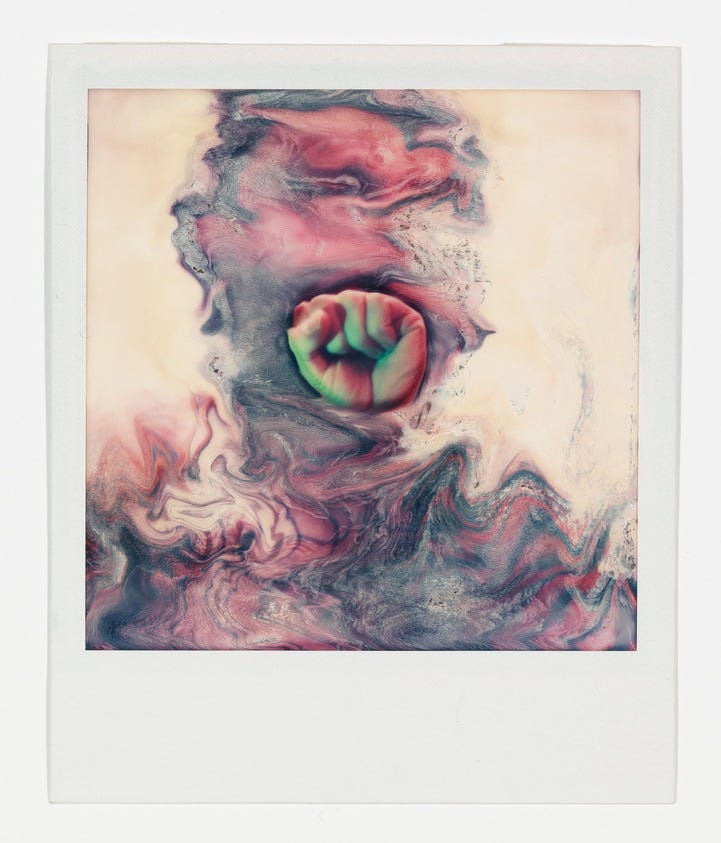
Part of the magic, of course, lay in the ritual. To use an SX-70 is to perform a small act of engineering theater: unfold, focus, click, watch. The print slides out and begins to change before your eyes—first as a faint negative, then slowly resolving into full color. This “moment of becoming” sets instant photography apart from digital’s instantaneous fixity. The instant print is a performance in itself, a social object passed around, touched, and commented upon—often before it has fully developed. Moreover, unlike digital files, each Polaroid print is a singular object—its chemistry vulnerable to heat, light, and handling. Colors might shift toward magenta, borders could yellow, emulsions can crack. These imperfections become part of the photograph’s biography, evidence of a life lived outside the sterile purity of digital storage.
Financially, the SX-70 was a high-stakes bet for Land. Development reportedly cost $600 million in today’s dollars, a staggering sum for a company of Polaroid’s size.11 Initial sales were strong, but the high cost of both the camera and film limited broader adoption. By 1974, Polaroid was selling hundreds of thousands of units annually, but Land’s vision of the SX-70 as a universal household device never materialized. Business scholars have cited the SX-70 as an example of “radical innovation” that disrupted internal processes as much as markets.12 But innovation was not to be enough. Through the 1980s and 1990s, Polaroid released cheaper cameras and new film formats, but digital imaging’s rise steadily eroded its market. In 2001, the company filed for bankruptcy. In 2008, it ceased production of instant film, a move widely seen as the end of an era.13
That same year, a group of enthusiasts formed The Impossible Project, acquiring Polaroid’s last film factory in the Netherlands and painstakingly reverse-engineering the chemistry. Early films were temperamental, but over time they improved, eventually leading to the rebranding as Polaroid Originals in 2017, and finally, the revival of the Polaroid name in 2020.14 For a few years at least, the SX-70, restored and resold, found a new generation of users—artists, collectors, and analog loyalists.15 Surprisingly perhaps, the intimacy of SX-70 prints has also appealed to contemporary artists raised in the digital era. Photographers such as Mikael Kennedy have used the camera to create travel diaries, imbuing their landscapes with the quiet authority of a single, unalterable print.

In an age where every image can be endlessly retouched, the SX-70 imposes a discipline: the frame you get is the frame you keep. That constraint far from stifling creativity, often sharpens it. The absence of a “delete” button demands a different kind of looking, a more deliberate composure before the shutter is pressed. That difference is more than technical; it is philosophical. Digital photography — and the social media platforms that quickly embraced it — trained us to think of images as endlessly replicable, malleable, and disposable. The SX-70 belongs to a culture of scarcity. Every exposure has a cost, and every print has a life. Its colors shift as the dyes age; the image can be bent, smudged, or even destroyed. In this fragility lies its paradoxical permanence — not in terms of archival stability, but in the sense that each print is a witness to a particular moment, one that will never recur in quite the same way.
It is telling that the SX-70 has endured not only as a nostalgic object but as an active tool.16 Restoration specialists still refurbish original bodies; Polaroid continues to produce film packs; online communities trade tips on maintaining the folding mechanism and coaxing the best color from modern emulsions. The Impossible Project’s revival of SX-70 film was not driven by mass-market economics — the audience was too small for that — but by an almost philosophical conviction that the medium itself was worth saving. In a market dominated by megapixels and computational photography, the SX-70’s appeal has nothing to do with keeping up, and everything to do with slowing down.
I have owned two SX-70s in my life, and the “slowing down” is perhaps the most radical thing about the camera in the twenty-first century. You unfold it with a mechanical snap, focus it manually with a little black dial, frame the image with care, press the shutter towards you, and then simply wait — thirty, sixty seconds — for the image to appear. To do so is to step outside the prevailing logic of instant gratification. That wait alters your relationship to the photograph. It is no longer an afterthought to the moment; it is part of the moment in a way no digital—or even film—image could ever be.
In the end, the SX-70 remains an object suspended between eras: born of 1970s optimism in design and engineering, surviving into a digital present that prizes speed but often longs, quietly, for permanence. Its survival suggests that not all progress is linear.17 Some technologies, once perfected, do not need replacing so much as refining. Land’s creation still asks the same question it did in Miami Beach in 1972: what if a camera could turn light into memory, and do so in a way that made you believe, if only for a moment, that you had just witnessed something magical?
I have been reading about quantum physics this year, and I have come to wonder if there is really no such thing as memory. Perhaps remembering is really a form of time travel, and when we hold a Polaroid in our hands we are, somehow, transported back to the exact point in spacetime of its creation. If so, then a Polaroid SX-70 is not just a marvelous camera. It is a time machine, and therein, as Edwin Land dreamed long ago, lies its real magic.
Harry McKraken, “Polaroid’s SX-70: The Art and Science of the Nearly Impossible,” Technologizer, June 8, 2011, https://technologizer.com/2011/06/08/polaroid/index.html.
Joaquín de Prada, “How Polaroid bet its future on the SX-70,” www.opensx70.com. https://opensx70.com/posts/2021/01/bet.
“Polaroid SX-70,” Wikipedia, https://en.wikipedia.org/wiki/Polaroid_SX-70.
Harry McKraken, “Polaroid’s SX-70: The Art and Science of the Nearly Impossible.”
Harry McKraken, “Polaroid’s SX-70: The Art and Science of the Nearly Impossible.”
Bonnie Christian, “The life, death and rebirth of instant film: a short history to celebrate Polaroid week,” WIRED, April 21, 2017, https://www.wired.com/story/polaroid-week-roundup/.
See below:
This exact wording appears in Polaroid’s original marketing copy and is verifiable from ad scans in the Library of Congress Polaroid collection and contemporary magazine placements.
Leslie Camhi, “Marrying Old and New: Walker Evans’s Polaroids and Roni Horn’s Photographs on View at Andrea Rosen,” Vogue, December 9, 2011, https://www.vogue.com/article/marrying-old-and-new-walker-evanss-polaroids-and-roni-horns-photographs-on-view-at-andrea-rosen-gallery.
“Lucas Samars,” Wikipedia, https://en.wikipedia.org/wiki/Lucas_Samaras.
Joaquín de Prada, “How Polaroid bet its future on the SX-70.”
Raghu Garud and Kamal Munir, “Socio-technical dynamics underlying radical innovation: the case of Polaroid’s SX-70 camera,” paper presented at the Academy of Management Annual meeting, 2004, https://www.jbs.cam.ac.uk/wp-content/uploads/2020/08/wp0605.pdf.
Bonnie Christian, “The life, death and rebirth of instant film: a short history to celebrate Polaroid week.”
Devin Coldewey, “We’ve come full rectangle: Polaroid is reborn out of The Impossible Project,” www.techcrunch.com, March 27, 2020, https://techcrunch.com/2020/03/27/weve-come-full-rectangle-polaroid-is-reborn-out-of-the-impossible-project/.
The new Polaroid still sells instant cameras, though nothing like an SX-70: https://www.polaroid.com/en_us/cameras/now-camera.
See Branden J. Stanley, “The Polaroid SX-70 - A Review of the Instant and Timeless Classic,” www.thatvintagelens.com, July 11, 2019, https://www.thatvintagelens.com/theblog/2018/7/9/the-polaroid-sx-70-a-review-of-the-instant-and-timeless-classic.
Note the recent retreat from in-car digital displays.